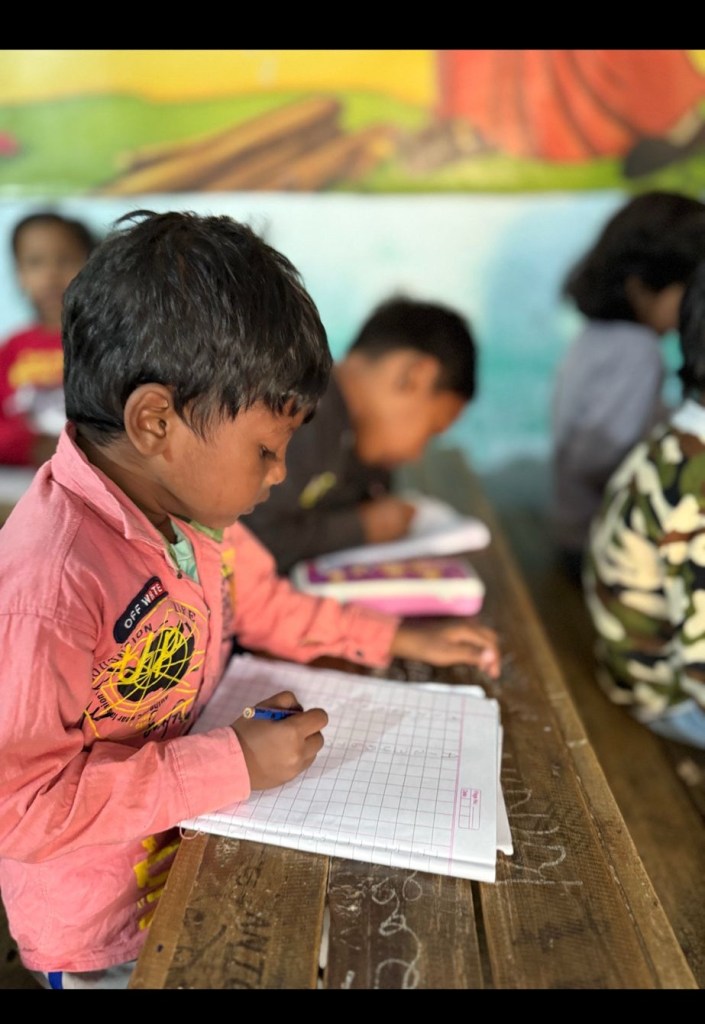
Education, in its most intrinsic form, is not about classrooms, examinations, or even uniforms. Ultimately, it is about gaining access, about gaining some measure of dignity, about gaining some chance, however small, however insignificant, about gaining some idealistic, unyielding, and quiet, belief in each and every single one of them, no matter what their world may be like. The partnership between Pehchaan- The Street School and @shailja.sps, in their act of providing notebooks to students, is a powerful symbol of drastic change in its most elementary form. In a world often swayed by big policy initiatives and grandiose rhetoric, it’s beautiful how this particular step serves as a poignant reminder that sometimes it’s all about the smallest things in life that truly change it all when compassion finds its way with action.
The notebook may be an ordinary object for us all, but in the case of kids who have been denied access to study material their whole life, it’s an object that becomes so much more than just an object, it becomes a part of who they are. A new notebook is “not just a collection of bound-together paper.” It is a “new beginning” and “a place to begin to write stories, learn numbers, think through ideas, and learn to have confidence.” In classrooms where children learn outside traditional classroom environments, such as those on the “street schools,” basic resources such as these are often lacking but also necessary to the learning process.
In today’s world, think about what happens to that little boy or little girl when they’re handed that new notebook. There is an internal change, an internal transformation and an internal sense of ownership, there’s pride, there’s belonging, or as one might say, “The world of learning.” The statement that, “Because every dream starts on a fresh page,” is not merely an exaggeration, but truth. A dream must have a vehicle in which it can grow, and it’s called education.
So this is what happened because of people working together on this project. Notebooks are not things you buy at a store anymore. They started to mean something. Notebooks and children can actually help make things happen and give people power. Notebooks and children can do this together.
Education is really about something simple. It is not about being in a classroom or wearing a school uniform or getting a diploma. Education is about access to things that can help you. Education is about being treated with respect. Education is about having a chance to do things. This is why the link between Pehchaan- The Street School and @shailja.sps, which was founded in response to something so simple, yet so profound, in the distribution of notebooks to students, is such a powerful reminder of the effect of small actions.
In a world that is often preoccupied with big policies and big promises, this project reminds one of the very human nature of change, which begins with small steps when compassion and action come together. A notebook may be an ordinary thing, but for a child who has not had the chance to learn, it becomes a symbol of identity. Pehchaan- The Street School has been consistent in its dedication to an alternative form of education.
This is reflected in its understanding of the need to adapt to the reality of the child, not the reality the educational establishment seeks to create. In its attempts to take education to the street, to the community, Pehchaan- The Street School has sought to dislodge traditional notions of the educational space as being located behind walls.
For them, the mission goes beyond the education of the children in terms of literacy and numeracy skills, but also to instill a sense of dignity, self-identification, and self-confidence within these children, who otherwise remain invisible to the education system in the country.
Everything they undertake, whether through educational drives, awareness campaigns, or association with the community, is an extension of a broader platform of justice through education.
This collaboration fits very well within that vision. This is not charity, it is partnership. This is not a one-shot aid, it is a commitment that we share to the value of continuity in learning.The contribution here by @shailja.sps epitomizes the kind of leadership which asks for no applause but brings change. The facilitation of education through material provision might sound so simple, but it is one of the most straight-forward modes of strengthening learning environments.
The reason for this initiative is that people have an understanding of the problem. The problem of access to education is not about having schools and teachers. It is also about the things that education needs to work like notebooks, books, pencils and a safe place for students to learn in the classroom. The initiative is trying to make sure that education has all the tools it needs including things like notebooks and pencils and a safe classroom environment where students can focus on their education. The issue of access to education is really about all of these things, not schools and teachers but also the tools, like notebooks, books and pencils.
True social value is not created through visibility, but through consistency, authenticity, and responsibility.
This partnership reflects all three. One of the most important aspects of initiatives like these is that children are no longer beneficiaries of “charity,” but beneficiaries of “dignity” or respect. They’re not beneficiaries who require some type of aid, but beneficiaries that can think, can lead, can be leaders. Giving children learning tools is not an act of “sympathy” but an act of “justice” on our part.
A journal held by a child reads: “You matter. Your education matters. Your thoughts matter.”
This psychological affirmation is as important as its very physical resource. It contributes to self-worth, empowerment, and feeling connected, which are core aspects of a holistic philosophy of education.
Education is positioned as being solely the duty of institutions. In actuality, however, it is a common responsibility socially. The ecosystem in enabling or restricting access to learning is formed by families, communities, organizations, individuals, and institutions.
But such a collaboration points to the fact that meaningful change does not need massive infrastructure; what it is asking for is shared intention. When people and organizations come together with purpose, even the smallest of contributions can be the onsets of large transformations.
It shows that scale alone is not the game in social impact, but sincerity, sustainability, and alignment of values.
Not every impact story is loud. There are impact stories told quietly, in the way a child carefully opens his or her first new notebook, in the way that first page is covered in handwriting, in pride of carrying school materials, in excitement of learning something new.
These kinds of instants do not often receive media attention, but they have a lasting impact.
So each notebook used has its own history, its own role in a person’s journey: a first sentence, first scribble, first math problems solved, first story written on its pages.
Material support is necessary, yet belief makes all the difference. For children who feel seen, who feel the support, the experience with education changes entirely. Instead of a burden, it becomes a possibility.
This collaboration accomplishes two important things: it offers resources, and it builds belief.
Essentially, it lets children know that there is someone out there who cares about education and their future.What is important in this methodology is not only the contribution, but the ideology behind making this contribution. This is a collaborative model based upon respect, mutual purpose, and a vision.
This is not an isolated action in terms of social impact; instead, it describes a continuous process of social impact as a “relationship” involving different communities, organizations, and learners.
Such is the way in which sustainable change transpires, not in isolation but in collective effort. Although it may appear to be a small notebook, its effect is amplified by its repeated purpose, learning, or growth. Therefore, by multiplication, it means transformation for many children.
This is the ripple effect in compassion: A notebook leads to learning whereas learning results in confidence. Confidence leads to aspirations and aspiration brings about opportunities Small acts are all part of a larger chain of change.To children struggling with poverty, instability, and marginalization, education is also “a bridge ,-a bridge to opportunities, autonomy, and self-determination.” Initiatives such as this continue to fortify this bridge.They remove obstacles. They create access. They revive hope. The partnership between Pehchaan- The Street School and the social activist @shailja.sps is a humble yet inspiring example of how social commitment can create a significant difference, proving that sometimes it is simply a pen and a notebook that can spark a big change! Yet in this simplicity, something profound is hidden away beliefs in children, beliefs in education, and beliefs in equity.
For every notebook, there is the promise of a lesson to be learned. For every page, the possibility for change exists. For every child, the future rests in their hands.
 Site Title
Leave a comment