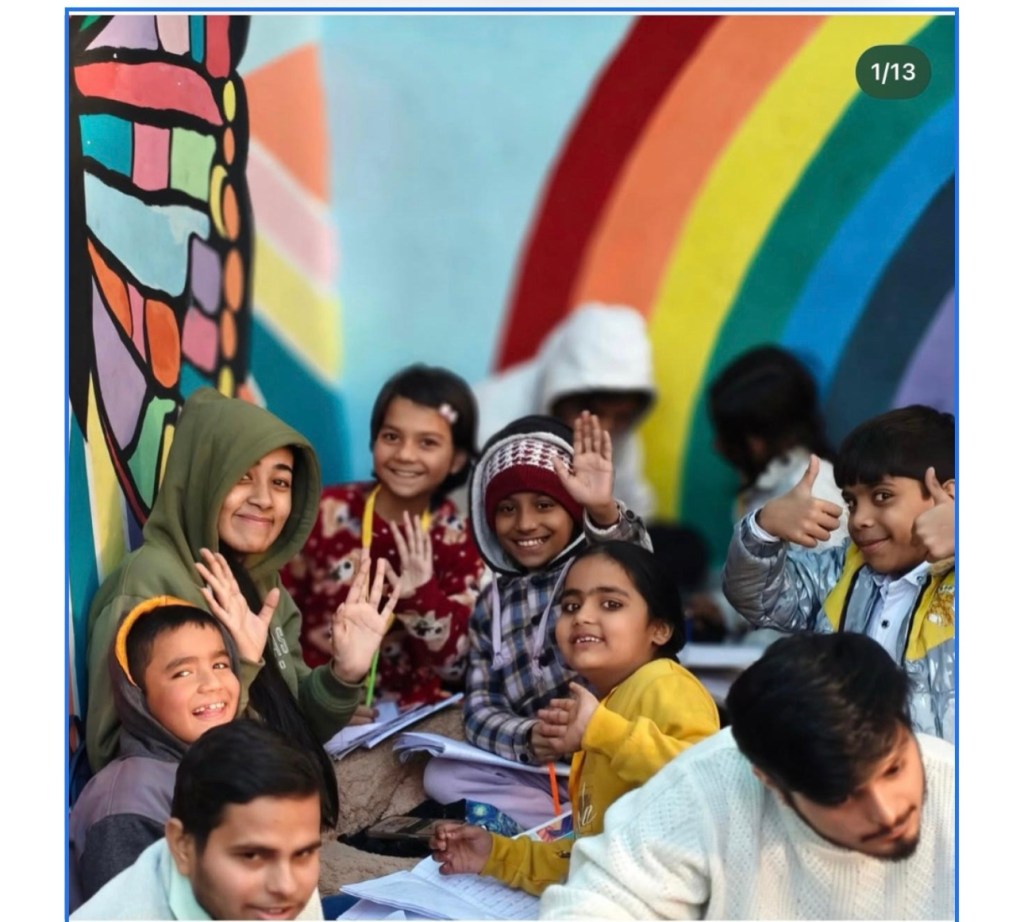
In a world that tends to value everything in statistics GDP, growth rates, and digital outreach there exists a deeper, qualitative process of growth that occurs in lanes, under flyovers, and alongside traffic signals. This is where hope learns to coexist with scant means and unending resilience. What follows is a tale of hope and survival, of compassion yielding to commitment, of a simple candle flame serving as an allegory of education and dignity, in a partnership between Pehchaan – The Street School and Light TheLove.
At first glance, this is a relatively minor act: handcrafted candles awarded to volunteers. But within this gesture is the complex tale of thankfulness, shared purpose, and the belief in change not through institutions alone but through the people who show up.“Pehchaan – The Street School” is not just an educational endeavor but a revolution in itself. It aims to reverse the lost childhoods of so many because of poverty, displacement, and neglect. The organization operates in a manner that involves mostly children living on the streets, children involved in rag-picking activities, or begging, or child labor and challenges how schooling is perceived. Schooling is not a routine for them. It’s a disruption. A disruption in the cycle of normalized deprivation.
With the introduction of classrooms in the streets and not the other way around, as the children typically would, Pehchaan- The Street School again rewrites the definition of access itself. Volunteers meet the children in the sidewalks, teach them alphabets alongside the tea stalls, and discuss dreams in places where society would usually turn a blind eye. With all this, they convey a powerful message about education that it is not a privilege to be earned , but a right to be honoured.
However, the emotional labour herein is immense. Volunteers navigate trauma, irregular attendance, hunger, and societal apathy. Morale is kept up in such spaces through recognition, which is not for validation but just reassurance that someone has been counting.
Light TheLove enters this narrative not just as a brand, but as a certain philosophy.
Working with Pehchaan- The Street School , Light TheLove extends its ethos from aesthetics into impact. The candle, in this context, becomes symbolic, symbolizing hope that persists in fragile circumstances.The giving of candles to the volunteers in Pehchaan-The Street School was not based on gaining something in return. The giving was relational. It was saying, “We see you.” In the sector where volunteers are frequently burnt out and appreciation is a rarity, this means a lot. It’s a reminder to the volunteers that they are part of a bigger cycle of empathy, a cycle in which different acts of service are drawn from different people to achieve a collective purpose.
The candle means a lot more to the volunteers. This symbolizes the nights spent educating by the dwindling light of the candle. The children are also proud to write their names for the first time in their lives. All small successes make up the future. The lighting of this memento in one’s place becomes a ground for reflection.
What makes this collaboration noteworthy is its refusal to frame impact narrowly. Instead of reducing engagement to mere funding or visibility, Pehchaan- The Street School and Light TheLove show values-based partnerships can deepen social change.
This collaboration underlines three critical lessons for the development sector:
Not all impacts are quantitative. While metrics are very important, emotional nourishment is equally crucial. Recognizing volunteers for their effort assists in the retention of volunteer talent and supports long-term involvement. Brands can participate ethically. Light_TheLove’s involvement does not take the limelight off the cause. The candle is simple but possesses the power to inspire renewal in terms of motivation, acceptance, and inspiration to serve.
From a legal perspective, this combined effort is also compatible with India’s education guarantee under its Constitution. Article 21-A of the Constitution of India states: “Every child has the right to education. The state shall provide free and compulsory education to all children between six and fourteen years of age,” thereby making education a legal right for children between 6 to 14 years of age. Despite this provision, there is a vast gap between the underprivileged children who tend to be on the periphery of legal systems unregistered at the time of birth, unschooled in formal systems of education, and are prone to be exploited. The need for interventions such as Pehchaan- The Street School arises since there are bridging functions between constitutional aspirations and grass-root realities. Rights are implemented through relationships. In this regard, partnerships for the enhancement of such initiatives are not charity but are rather part of constitutional morality.
The story of social change tends to focus on founders, philanthropists, and institutions, but it seldom stops to pay tribute to volunteers: people who donate their time without expectation of return. Many volunteers with Pehchaan- The Street School are students or young professionals trying to balance their personal dreams with their sense of social responsibility. They teach not because it is simple but out of necessity. They choose to be there in person rather than make life easier. The recognition from Light_TheLove thus affirms their efforts-not out of obligation but out of a choice worth respecting.
However, beneath the surface-level significance of candlelight and appreciation, there is also an undercurrent with respect to the societal perception of contributions and value. The perception of children living on the streets is one of the deficits that which they lack, that which they require, that from which they are denied. The impact of Pehchaan- The Street School ’s efforts, in collaboration with the likes of this initiative, is to reverse that perspective in terms of what might be possible. Appreciation of the volunteers lends an increased sense of belonging to them and directly correlates to the quality of attention provided to the children.
This collaboration also points towards the sustainability of the social sector. Grassroots groups tend to perform under conditions that border upon scarcity: emotional, financial, and institutional. While the need for policy change and finance is well-recognized, the need for sustainability is also equally important. This can only happen if human capital is also taken care of. This collaboration between Pehchaan The Street School and Light_TheLove is an example of how, for social groups working under difficult conditions, the need for emotional or similar working conditions is also very significant.
This collaboration provides an example that can be repeated in socially aware participation in an increasingly commercial world. It demonstrates that brands can maintain their distance from the societal reality that they represent, while NGOs do not have to abandon their values in order to benefit from their cause. With such cooperation built on respect rather than recognition, the results can be both ethical and sustainable. The illumination provided in such an initiative, thus, is not only in candles or classes, but in a vision.
This initiative by Pehchaan – The Street School and Light TheLove urges a paradigm shift in thinking about impact production. It encourages a brand to be genuine with social causes, and NGOs need to feel comfortable with collaborations that match their beliefs. More specifically, this initiative urges society to remember that it is not huge actions that cause change but small, ongoing, and caring actions that can actually make a difference. Each lit candle produces the story of a child who can read, but each flickering flame spells the uncertainty that lingers in the lives of children. And with every spread of light, it symbolizes what is possible when empathy becomes action.
This partnership is much larger than lighting. This partnership is about realizing humanity in service. This partnership is about understanding that teaching requires much more than books. This partnership between Pehchaan- The Street School and Light TheLove proves that purposeful design can create not just an impact but inspire.
When activism has come to mean more about performing and hashtagging, this alliance is a reminder that real change is often quiet, consistent, and comes from a place of care.
And this light shall pass on from the streets to the classrooms from the hands that teach to the hearts that believe and from the one candle to the collective conscience of our communities today, and this light shall pass on from the streets to the classrooms.
In essence, this collaboration is a gentle reminder that hope is not often brought by grand promises and sweeping changes but by presence, care, and the simple gesture of being there with those who often go unnoticed. In the simple act of a volunteer being with a child on a pavement or in lighting a candle to recognize this gesture, there is a common understanding that each life is valued and that every gesture of kindness, however small, holds the power to bring about change.
Pehchaan – The Street School and Light_TheLove further teach us that the strength of change arises where the strength of empathy can be translated into action. They also remind us that in helping to light the way for others, the smallest light is often enough to banish the darkness.
 Site Title
Leave a comment